
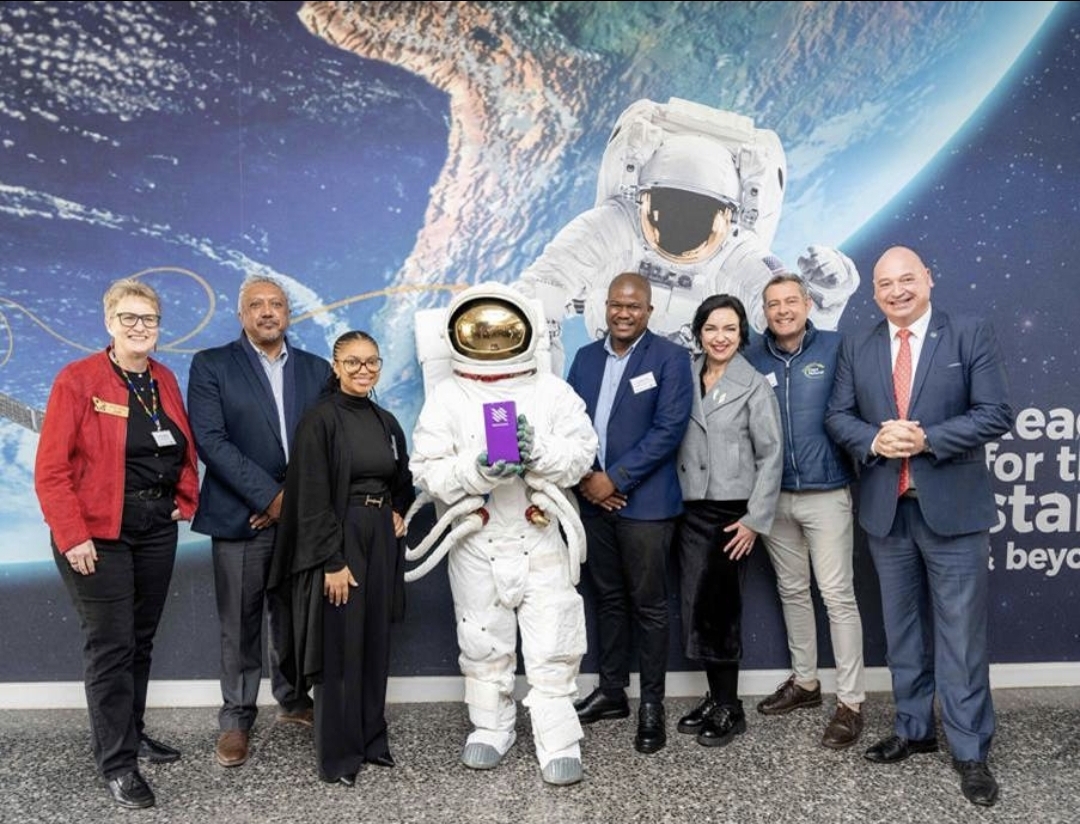
South Africa’s iconic Rooibos is preparing for an out-of-this-world journey.
In a first for the country, Rooibos seeds will be sent to the International Space Station (ISS) this October as part of the Rooibos in Space programme, a pioneering initiative combining agricultural research, space science and STEM education.
Launched this week at Parklands College’s Innovation Centre in Cape Town, the project brings together the South African Rooibos Council (SARC), MaxIQ Space and the South African National Space Agency (SANSA), with support from educators, scientists and government representatives.
Taking an indigenous plant beyond Earth
The project will see Rooibos seeds exposed to the unique conditions of space, including microgravity and cosmic radiation, for several weeks aboard the ISS.
Once the seeds return to Earth, they will be planted alongside a control group that remained on the ground. Learners and researchers will compare how the two groups perform by studying germination, growth, resilience and yield.
The experiment forms part of a growing international interest in understanding how plants respond to space environments as scientists look towards future long-duration missions and sustainable food production beyond Earth.
Cederberg learners take part in real scientific research
One of the most exciting aspects of the initiative is that learners will be directly involved in the research.
Seven schools in the Cederberg, the birthplace of Rooibos, will conduct the comparative planting study alongside local Rooibos farms. A parallel experiment at Parklands College will provide additional data.
The programme gives learners hands-on experience in scientific research while introducing them to plant biology, agriculture and space science through curriculum-aligned STEM activities.
To encourage even wider participation, learners across South Africa will also have the opportunity to design the official Rooibos in Space mission patch during July and August.
Why this matters
While Rooibos is already recognised worldwide as one of South Africa’s most distinctive agricultural products, this project places it at the centre of cutting-edge scientific research.
The initiative also highlights South Africa’s growing role in the global space sector while creating opportunities for young people to engage with science, technology, engineering and mathematics in meaningful ways.
As international agencies continue researching how crops behave in space to support future lunar and Mars missions, South Africa’s indigenous Rooibos will soon become part of that global scientific conversation.
The Rooibos seeds are expected to launch to the International Space Station in October, with updates on the mission and the learners’ research to follow in the months ahead.
For more information and project updates, visit the South African Rooibos Council’s official website.






Leave a Reply