
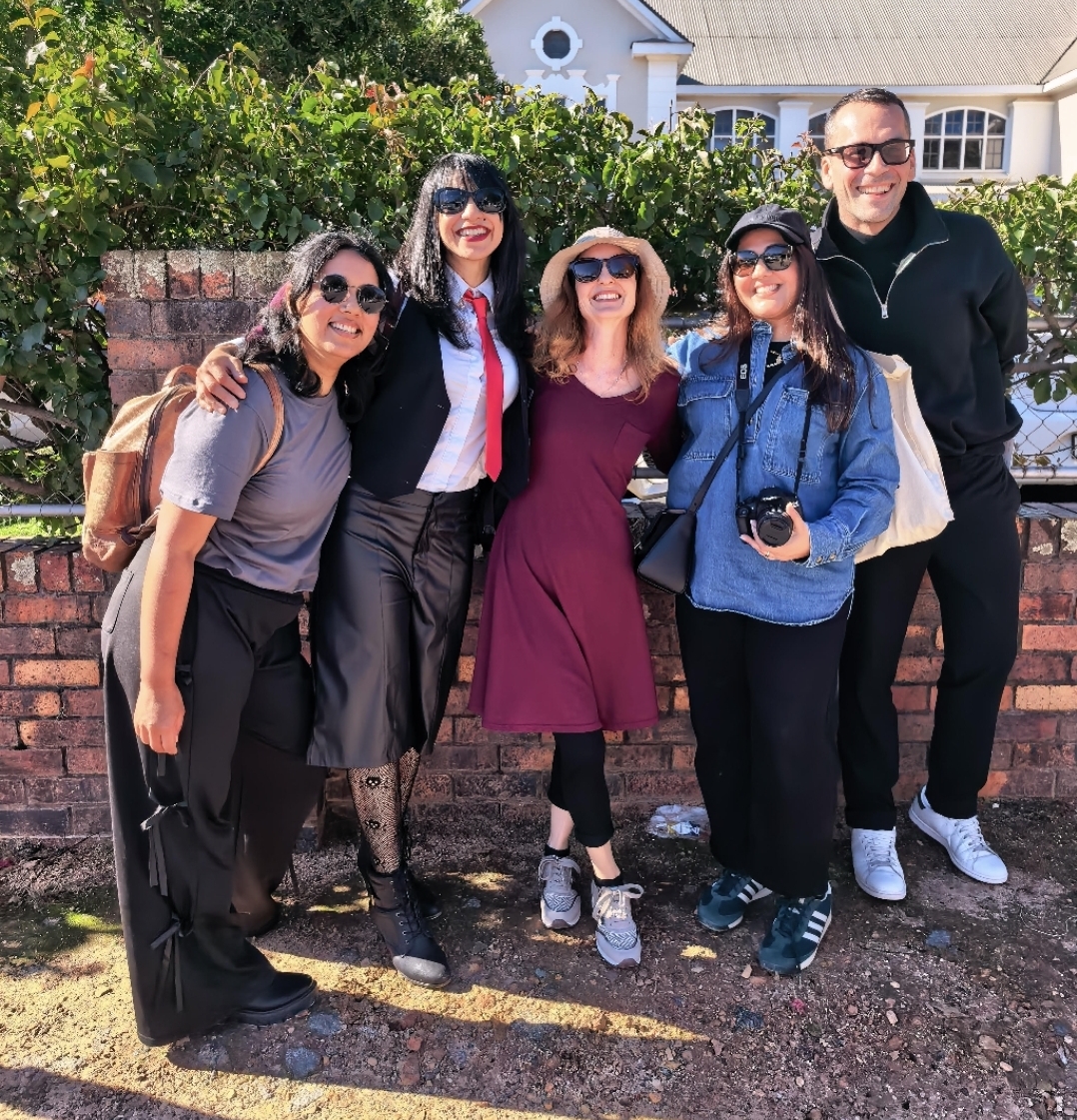
FAZIELA Harris Davids
There’s something almost unreal about Franschhoek during the Franschhoek Literary Festival.
The mountains wrap themselves around the small town like a painting, wine trams drift past cottage-lined streets, and tucked between wine estates and cafés are rooms filled with conversations about books, publishing and the people brave enough to tell stories that matter.
This year, with the encouragement of 3 Goose Media, I attended the festival for the first time. I arrived carrying equal parts excitement and uncertainty, unsure what to expect from a space so deeply rooted in literature, publishing and creative conversations.
What I found instead were discussions that lingered long after the panels ended.
The power of speculative fiction
One of the standout sessions I attended was hosted by Marius Du Plessis from Mirari Press and featured authors Conrad Kemp, author of Out of the Dead Lands, and Wamuwi Mbao, author of Sea Ice.
The conversation, titled Inventing Tomorrow: Exploring the Power of Speculative Fiction in Reshaping African Storytelling, explored how speculative fiction allows African writers to imagine futures beyond limitation, survival and inherited narratives.
The panelists were insightful, thoughtful and refreshingly honest. The discussion flowed so naturally that the hour felt far too short.
I found myself scribbling down notes almost immediately, afraid I would forget the feeling of hearing imagination spoken about not as escapism, but as necessity.
The biggest thing I took from the discussion was this: speculative fiction gives us permission.
Permission to imagine beyond survival. Permission to reshape reality. Permission to tell stories rooted in our own worlds while still dreaming beyond them.
Why human storytelling still matters
In a time where AI-generated content is rapidly growing, one part of the conversation stayed with me deeply.
The panel reminded me that the smallest human details are still where true storytelling magic lives. Memory. Culture. Language. Grief. Humour. Folklore. Shared understanding.
Speculative fiction does not remove us from reality. It allows us to confront reality differently.
Another important thread throughout the discussion centred around publishing itself and the invisible limitations many writers inherit without realising it.
Who decides which stories are considered “universal” enough to matter?
Publishers hold immense power in opening doors for emerging voices, especially African voices, but readers and writers also carry responsibility in questioning the boundaries we have unconsciously accepted for years.
The accessibility problem in publishing spaces
As beautiful as Franschhoek was, its beauty also highlighted something heavier.
Spaces like literary festivals, publishing panels and networking conversations often remain inaccessible to many local writers, especially writers of colour and writers outside major city centres.
Too many talented storytellers are excluded before they have even entered the room.
It also made me think about how African writers are still often expected to soften or over-explain their stories for international audiences.
Why are African writers expected to dilute their voices when many of us grew up consuming stories from elsewhere without asking for glossaries or explanations for foreign food, slang, traditions or cultural references?
We learned their worlds without demanding they make themselves smaller for us.
Our stories deserve the same freedom.
Leaving Franschhoek with a reminder
Maybe that is what stayed with me most after leaving Franschhoek.
The reminder that African stories were never lacking polish or value. They were simply waiting for spaces willing to hear them exactly as they are.
And perhaps that is where the future of African storytelling truly begins.



Leave a Reply