
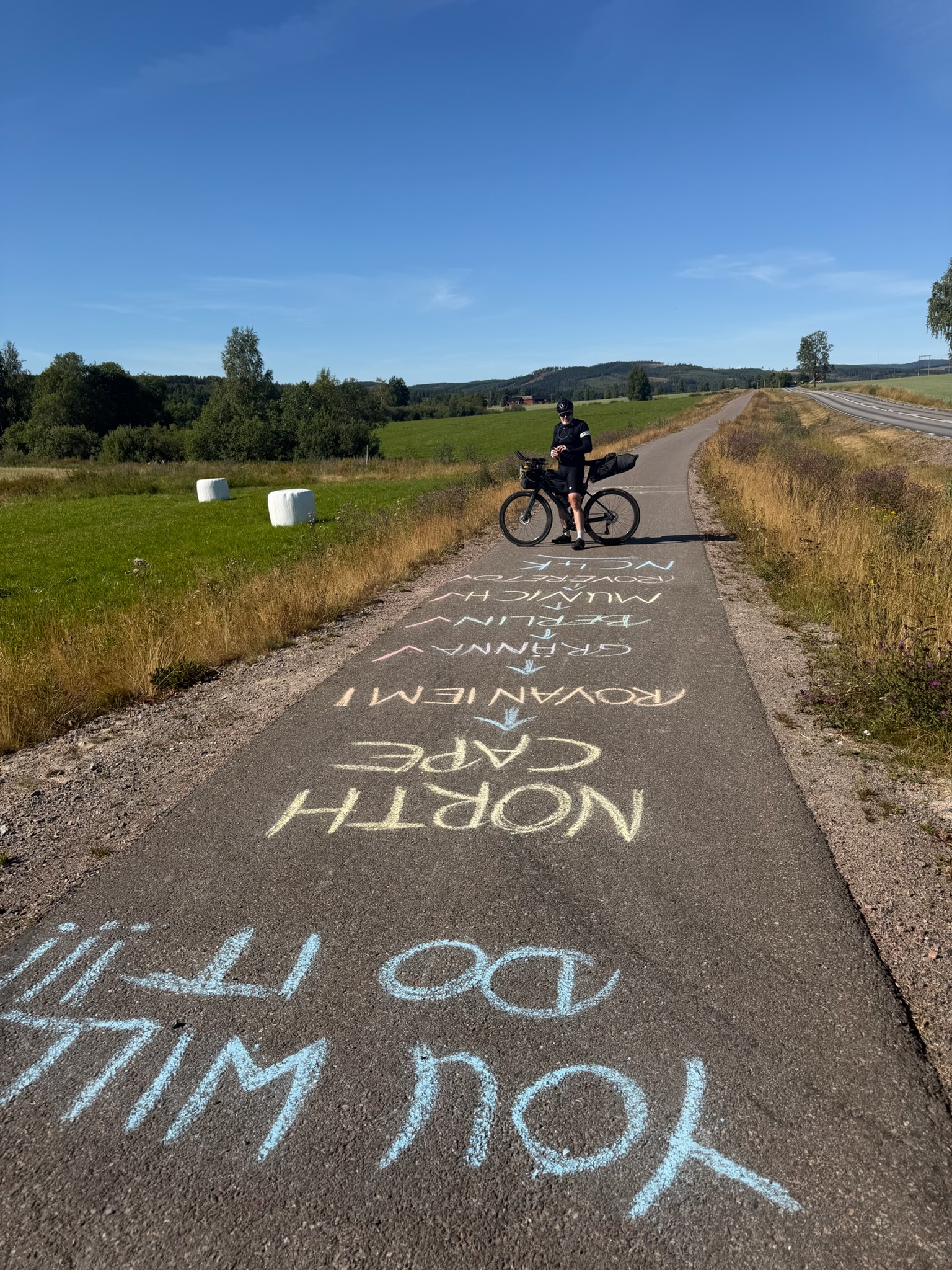
More than 4,000 kilometres. Eight countries. Over 30,000 metres of climbing and more than 660,000 pedal strokes.
Completing the NorthCape4000 would be an extraordinary achievement for any cyclist. For Parkinson’s advocate and former Absa CEO Arrie Rautenbach, however, the journey carried a much bigger purpose: showing that a life-changing diagnosis does not mean the road ahead has disappeared.
Rautenbach recently reached Norway’s North Cape after cycling 4,062.5 kilometres from Rovereto in Italy as part of the gruelling NorthCape4000 ultra-distance cycling challenge.
Along the way, he climbed 30,301 metres, almost three and a half times the height of Mount Everest, and completed an incredible 661,159 pedal strokes.
But those numbers only tell the part of the story people could see.
The Parkinson’s nobody sees
“Parkinson’s disease is not just a tremor. It is the non-visible symptoms that have the biggest impact on your life,” says Rautenbach.
Behind the kilometres were cramps, exhaustion, poor sleep, digestive and bladder problems, vivid dreams, medication side effects, illness, apathy and the unpredictability that comes with living with Parkinson’s.
For Rautenbach, taking on the NorthCape4000 was never simply about proving he could cycle 4,000 kilometres.
It became a very public demonstration of what living with Parkinson’s can actually look like.
The disease is commonly associated with tremors and movement difficulties, but its effects can extend well beyond visible symptoms. Dopamine plays an important role not only in movement but also in motivation, energy and reward.
Sometimes, Rautenbach explains, the challenge isn’t physically being able to move. It is finding the motivation to move at all.
“Parkinson’s doesn’t adjust to your plans,” he wrote during the ride. “It comes when you least expect it and drives its own plans. You have to adjust.”
That became one of the defining lessons of his journey.
When the road doesn’t follow the plan
The NorthCape4000 is a self-supported endurance challenge, meaning riders must manage their own food, accommodation, equipment and recovery while making their way across Europe.
Rautenbach had another variable to manage: Parkinson’s.
There were long climbs, rain, cold, headwinds and illness, as well as the daily challenge of finding somewhere to eat and sleep.
Then his bicycle began to fail.
During one particularly difficult stretch, his chain started slipping. The problem progressively worsened until it was jumping on almost every pedal stroke.
“Mechanicals like this are mentally exhausting because you can’t fix it and you keep worrying if the bike will last to the end of the day,” he says.
But the struggling bike soon became an analogy for something much bigger.
Sometimes the bike doesn’t behave the way it should. Sometimes the body doesn’t either.
You adjust, and you keep going.
When Rautenbach’s Parkinson’s symptoms flared and poor sleep left him exhausted, expectations had to change too. A finish date that once appeared realistic had to be moved.
For him, changing the plan wasn’t failure.
It was a reminder that resilience doesn’t always mean pushing harder. Sometimes it means recognising when you need to adjust.
Meet Dr Watson
Along the route, Rautenbach had an unusual companion helping him through some of the hardest moments.
His name is Dr Watson, and he doesn’t actually exist.
The entirely fictional character has become Rautenbach’s imaginary partner in crime and the voice that helps him push through when things get difficult.
“I don’t consult with myself anymore. Dr Watson sets the tone,” he says.
There’s humour behind the idea, but also something deeper.
When dopamine deficiency makes motivation difficult, finding ways to create momentum becomes part of managing the challenge.
For Rautenbach, Dr Watson represents the decision to continue when his mind might be telling him otherwise.
Because sometimes the biggest mountain isn’t the one in front of you. It’s the one you’ve created in your mind.
One pedal stroke at a time
The final numbers are staggering.
Rautenbach covered 4,062.5 kilometres, climbed 30,301 metres and completed 661,159 pedal strokes.
But perhaps it is that final number that best captures what he wanted the journey to represent.
Nobody cycles more than 4,000 kilometres in a single movement.
You do it one pedal stroke at a time.
Then another.
And another.
It became a fitting metaphor for living with Parkinson’s. You cannot always control what tomorrow brings, but you can concentrate on what is in front of you today.
The people along the way
The ride also became a story about unexpected human connection.
Rautenbach met a German rider named Martin along the route, who eventually adjusted his own race to ride at Rautenbach’s pace as his symptoms and mechanical problems became more challenging.
“Riding with someone makes a huge difference and gives some certainty of backup,” Rautenbach says.
Another memorable encounter happened at a care facility in Germany.
After staff discovered he was living with Parkinson’s, they invited him inside for breakfast. Several people at the facility were also living with the disease.
It became another reminder of something Rautenbach discovered repeatedly during the journey.
“You just never know what lies around the next corner.”
There is still a road ahead
After rain, cold, steep climbs, mechanical problems, illness and exhaustion, Rautenbach eventually reached North Cape.
He was exhausted, but incredibly proud.
The significance of reaching the finish, however, stretches far beyond completing an ultra-distance cycling challenge.
This wasn’t simply about proving that someone with Parkinson’s could cycle more than 4,000 kilometres.
It was about challenging the idea that a Parkinson’s diagnosis automatically closes the door on adventure, purpose and possibility.
That message is also at the heart of the Arrie Rautenbach Parkinson’s Foundation, which aims to provide information and support to people affected by Parkinson’s while reminding them that diagnosis does not mean the end of a meaningful life.
There can still be adventure.
There can still be purpose.
There can still be challenge and joy.
Most importantly, there can still be a road ahead.
Throughout his ride, Rautenbach repeatedly returned to gratitude. There were unexpected friendships and shared meals, incredible landscapes, reindeer in Sweden and the surreal experience of crossing the Arctic Circle.
“The true experience and beauty is to find the joy in every moment and emotion. Embrace it,” he says.
Perhaps that’s the biggest lesson from more than 4,000 kilometres on a bicycle.
Life doesn’t always follow the route we planned. Sometimes the weather changes. Sometimes the road gets steeper. Sometimes the bike breaks. Sometimes the body doesn’t cooperate.
And sometimes the battles nobody else can see are the hardest ones you’re fighting.
Rautenbach’s approach is to adjust when necessary, focus on what is immediately ahead and keep moving.
One pedal stroke at a time.


Leave a Reply