
What started as a university honours project in Gqeberha has grown into an international initiative reaching more than 300,000 learners across five continents. Now, Tangible, a coding programme born at Nelson Mandela University, has earned national recognition for its academic and social impact.
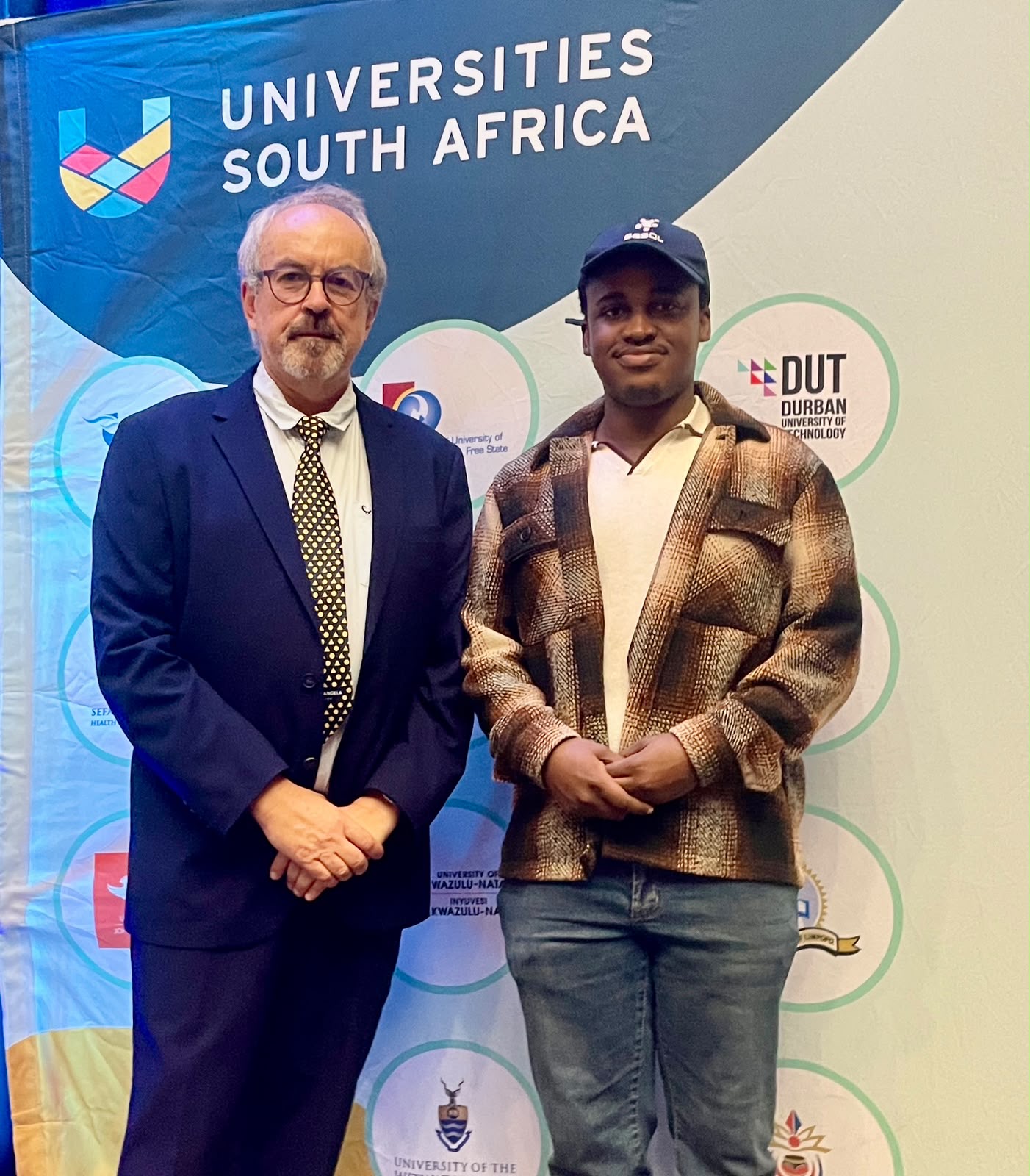
(IMAGE: Professor Jean Greyling and Katlego Nyambi represented Tangible at the Universities South Africa Higher Education Conference in Pretoria. Photo: Supplied.)
The project was recently selected as one of Universities South Africa’s (USAf) top 2025 academic impact case studies and was one of just three national case studies presented at the Universities South Africa Higher Education Conference in Pretoria on Friday, 9 October.
Professor Jean Greyling, Head of Computing Sciences at Nelson Mandela University and founder of Tangible, represented the project at the conference, alongside someone whose personal journey demonstrates exactly why initiatives like this matter.
From a Coding Workshop to a University Dream
Katlego Nyambi, from Soshanguve, first encountered Tangible while attending a coding workshop in Diepsloot during Grade 11.
At the time, his plans for the future were uncertain.
“Towards the end of Grade 11 I had no idea what I was going to do after school. I thought I did not have many options,” he recalled.
That introduction to coding changed things.
After the workshop, Katlego joined Tangible’s online C# coding club, where his interest in technology continued to grow.
While still at school, he said: “Now I know I want to study computer science at a university and I want to become a software engineer.”
Today, Katlego is studying towards a BSc in Computer Science at the University of Pretoria, supported by an Amazon bursary.
His journey is one example of how access to an opportunity, even something as simple as a coding workshop, can help a young person see possibilities they might never have considered.
Teaching Coding Without Computers
Perhaps one of the most interesting things about Tangible is that its approach to teaching coding doesn’t necessarily require a computer.
The initiative began in 2017 when Nelson Mandela University honours student Byron Batteson explored whether learners could be introduced to coding without computers, internet access or even electricity.
What started as an academic research project developed into a practical programme that helps teachers introduce coding and computational thinking through simple, hands-on activities.
It’s an approach particularly relevant in South Africa, where access to technology and reliable internet connectivity remains a challenge for many schools.
Instead of waiting for every classroom to have a fully equipped computer lab, Tangible gives educators tools to introduce learners to the thinking and problem-solving skills behind coding using resources already available to them.
A Gqeberha Idea Making a Global Impact
Since its beginnings at Nelson Mandela University, Tangible has grown far beyond the city where it started.
The programme’s global implementation is now led by the Gqeberha-based LEVA Foundation, with more than 300,000 learners across five continents reached through its coding activities and apps.
Its academic contribution has also been substantial, resulting in five journal papers, 12 conference papers, eight PhD studies and seven Master’s studies.
The recognition at the Universities South Africa Higher Education Conference highlights both the project’s academic achievements and its real-world impact.
And while the numbers are impressive, stories like Katlego’s offer a reminder of what those numbers actually represent: young people discovering new skills, new ambitions and potentially entirely different futures.
Not bad for an idea that started right here in the Bay.
For more information about Tangible, visit tangible.levafoundation.org.




Leave a Reply