
What does it mean to lead in a world shaped by inequality, rapid technological change and growing challenges facing students?
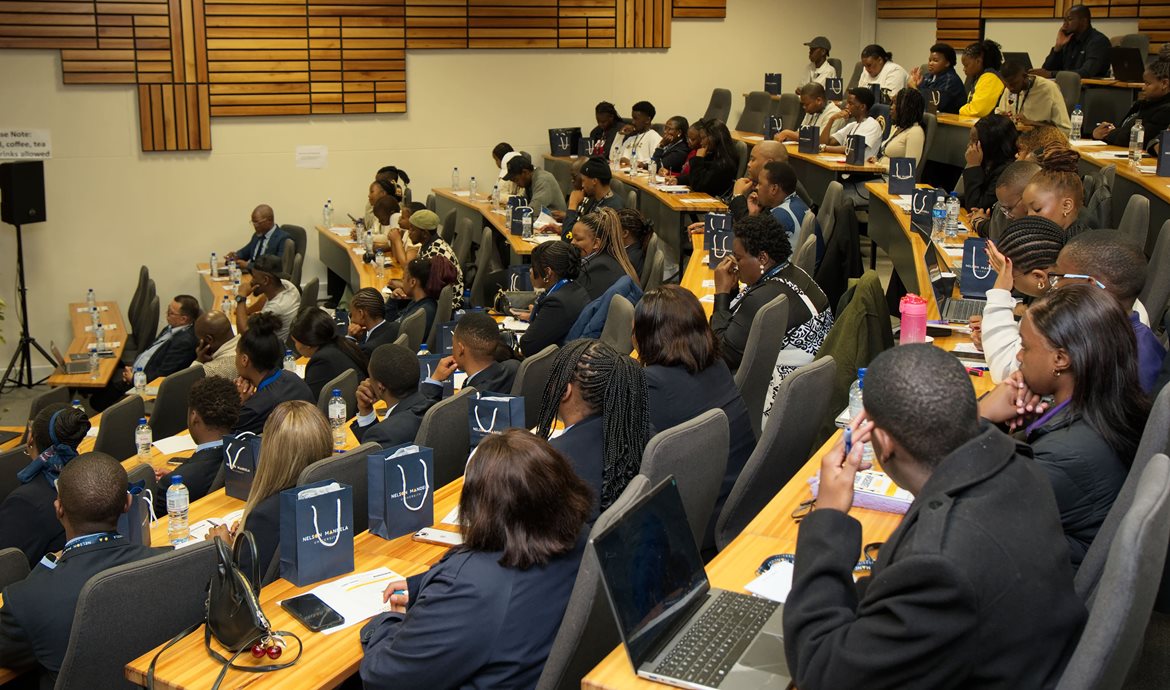
That was the central question at the 2026 Student Leadership Indaba, where student leaders from across the Eastern Cape gathered at Nelson Mandela University’s Business School Auditorium to explore how leadership can drive meaningful social change.
Held under the theme “Reimagining Student Leadership for Social Change and Innovation: Citizen Leadership and the Decolonial Imperative,” the two-day event brought together around 130 student leaders from Nelson Mandela University, Rhodes University, East Cape Midlands TVET College and, on the second day, the University of Fort Hare.
Leadership as service, not status
Opening the Indaba, Dean of Students Dr Sibusiso Mchunu challenged delegates to rethink leadership as an act of service rather than a position of authority.
Drawing on the principles of Ubuntu and the legacy of Charlotte Maxeke, Dr Mchunu encouraged students to consider whether universities are preparing graduates for the realities of today’s world or for one that no longer exists.
Keynote speaker Professor Bheki Ngomezulu, Director of the Centre for the Advancement of Non-Racialism and Democracy at Nelson Mandela University, echoed that sentiment by encouraging delegates to approach leadership through an Afrocentric and decolonial lens.
Rejecting the idea that young people are simply the leaders of tomorrow, he argued that students have a responsibility to lead today, urging them to become accountable, empathetic and responsive to the communities they serve.
Addressing the realities facing students
The first day of the Indaba focused on many of the challenges confronting students today, including funding, mental health, leadership burnout, entrepreneurship and youth economic development.
Throughout the discussions, delegates explored how effective student leadership depends on collaboration, institutional support and personal wellbeing.
On the second day, attention shifted to broader issues affecting campuses across South Africa.
Among the keynote speakers was Dr Thelma Oppelt, who highlighted the growing impact of gambling among students. She warned that financial vulnerability and limited oversight make students particularly susceptible to gambling-related harm, noting that gambling addiction often remains hidden until severe consequences emerge.
Interactive sessions also examined student safety, gender-based violence (GBV) and the role of leadership in building more inclusive campuses.
During discussions on campus safety, South African Union of Students President General Moses Nkambako stressed the importance of accountability, prevention and shared responsibility in tackling GBV.
Former student leader and current Ministry in the Presidency for Women, Youth and Persons with Disabilities spokesperson Nompumelelo Mkatshwa encouraged delegates to think strategically about activism.
Reflecting on her own leadership journey, she emphasised that while protest can bring attention to issues, lasting change is achieved through governance and meaningful structural reform.
The final session, led by Veli Mbele, explored Ubuntu and servant leadership as essential foundations for social transformation.
Preparing leaders for South Africa’s future
As the Indaba concluded, delegates reflected on the opportunities and responsibilities that come with student leadership in an increasingly complex society.
According to Dr Mchunu, universities play a critical role in developing ethical leaders and active citizens who can contribute to South Africa’s democratic future.
He noted that today’s student leaders face significant challenges, including financial exclusion, accommodation shortages, food insecurity, mental health pressures, graduate unemployment and rapid digital transformation.
“The Nelson Mandela University Student Leadership Indaba promotes citizen leadership as a framework for leadership renewal grounded in active citizenship, democratic participation, ethical stewardship and collective responsibility,” he said.
The event reinforced the message that effective leadership extends far beyond representation, requiring courage, accountability and a commitment to creating lasting change both on campus and within society.
For more Nelson Mandela University stories, visit our NMU news section: https://041online.co.za/tag/nelson-mandela-university/





Leave a Reply