
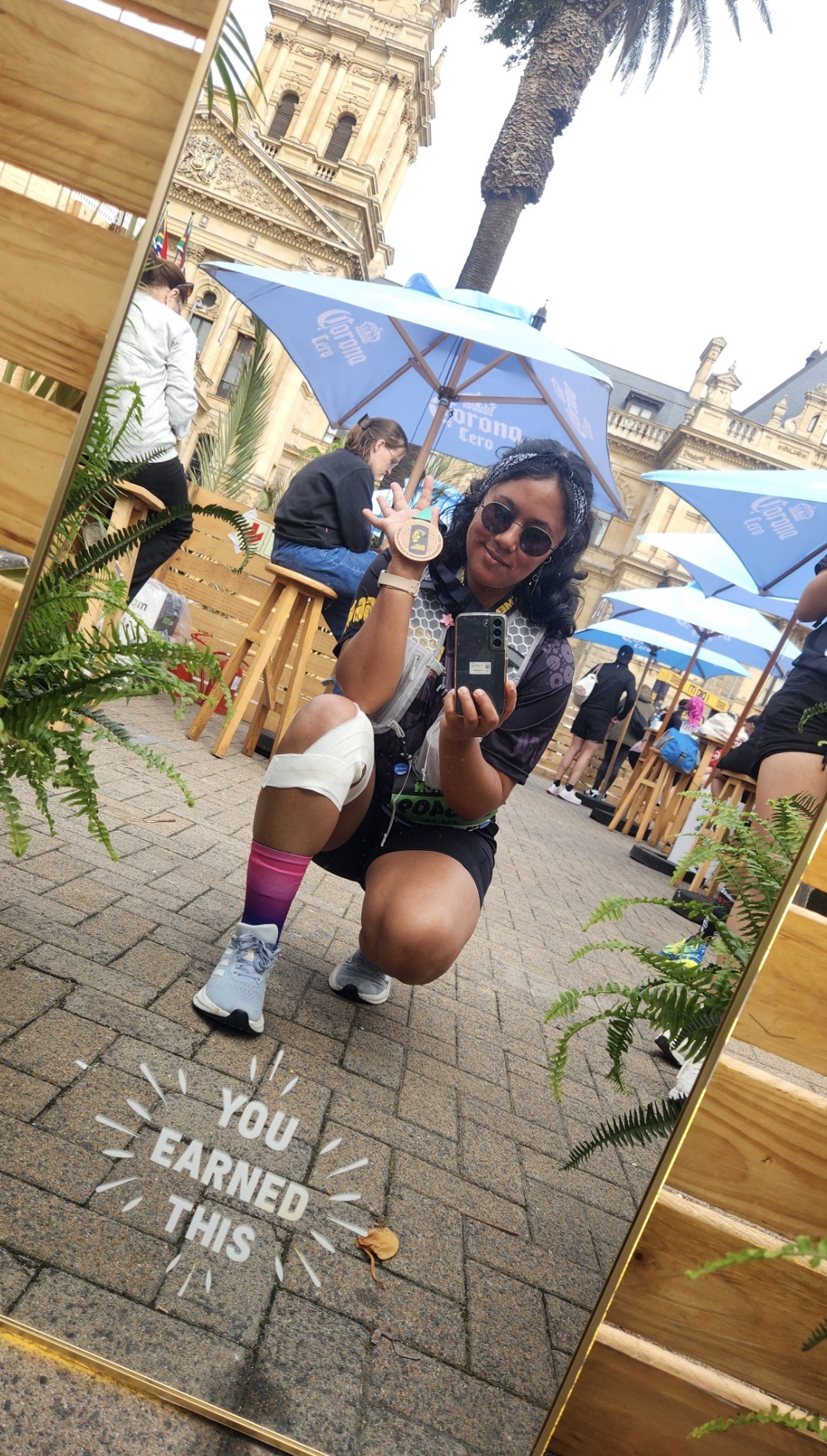
By FAZIELA HARRIS-DAVIDS
Cape Town’s inaugural Nelson Mandela Marathon brought thousands of runners onto the streets of the Mother City, delivering impressive performances, personal victories and a healthy dose of Cape Town’s famously unpredictable weather. But beyond the race results and record-breaking times, Faziela Harris-Davids discovered that sometimes the biggest achievement is simply showing up, surviving the hills and finding your own reason to keep running.
The nerves, the wind and the starting line
I’m going to be honest and say I was the most nervous I had ever been before a race this past Sunday. Despite a very rocky start, the sheer magnitude of the event had my stomach in a knot.
Yesterday, thousands of us traded our usual Sunday routines for running shoes, race numbers and the challenge of taking on the inaugural Nelson Mandela Marathon. The Mother City was awake early, the wind was doing what it did best (my contact lenses were not a fan) and the streets became a meeting place for athletes, supporters and neighbors standing on front stoeps wondering huh? As runners went by their doorsteps.
Being one of these many runners, I am by no means an elite athlete (in my mind perhaps) but that did not take away from the experience at any moment.
The inaugural event attracted 4,500 entrants for the 42-kilometre marathon, with another 22,000 athletes participating in the 21-, 10- and 5-kilometre races.
A running tour through Cape Town’s history
The marathon route offered runners a tour through some of the city’s most recognisable landmarks. From historic District Six which took me down a trip to memory lane, including a run by my old high school (Harold Cressy represent) .The Company’s Garden to the historic streets of Bo-Kaap, runners were treated to a route that carried the weight of the city’s history alongside its unmistakable beauty.
The route continued through Green Point before opening onto the coastal stretch along Sea Point Promenade and the Table Bay shoreline towards Milnerton’s Woodbridge Island.
Of course, Cape Town would not be Cape Town without making runners work for the privilege.
A fresh southeaster and cool conditions made the morning challenging, particularly during the opening kilometres, when the marathon runners faced a headwind on their way towards District Six. The wind later became an advantage for those heading west, before returning to test the field along the coastal stretch.
It was a reminder that running is as much about adapting as it is about endurance. You can prepare your training plan, choose your pace and lace up your favourite shoes, but the city will always have a little something of its own to contribute. Eish, Mother City, the diva that you are.
And that is part of the appeal.
Arthur Jantjies makes marathon history
The men’s marathon produced a thrilling contest, with Hopetown-born Arthur Jantjies of the Pan African Resources Club claiming the inaugural title in 2:15:14.
Jantjies remained among a leading group of runners for much of the race, with the decisive moves coming during the closing kilometres. By the time the contenders turned back towards the city with approximately two kilometres remaining, the field had narrowed considerably.
At the 40-kilometre mark, Jantjies made his move.
His winning time was a personal best, improving on his previous marathon best by approximately four and a half minutes. It was also another impressive achievement in a year that has already seen him win the Two Oceans Ultra Marathon and the 10-kilometre Peace Run.
Speaking after the race, Jantjies expressed his affection for Cape Town, describing the Mother City as nurturing to him.
Second place went to Tsépo Ramashamole in 2:15:24, just ten seconds behind the winner, while Moses Tarakinyu completed the podium in 2:15:34.
The closeness of the men’s finish made for an exciting inaugural championship, demonstrating the depth of competition among the athletes who lined up for the marathon.
Bize Beyira Negasa dominates the women’s race
In the women’s race, Ethiopia’s Bize Beyira Negasa delivered a commanding performance to secure the title in 2:36:42.
Running at a remarkably consistent pace, the Nedbank Running Club athlete gradually distanced herself from her competitors. By halfway, she had established a substantial lead, and she continued to hold that advantage through to the finish.
Negasa’s victory was another personal best, improving her previous marathon time by nearly four minutes.
South Africa’s Malineo Mahloko finished second in 2:43:53 after a strong late-race push, while Fortunate Chidzivo claimed third in 2:49:55.
Negasa’s winning margin of seven minutes and eleven seconds underlined just how exceptional her performance was, particularly given the challenging weather conditions.
Two champions. Two personal bests. One inaugural race that has already given Cape Town something to celebrate.
Koeksister Hill and the victories that don’t make headlines
Elite performances are what fill the headlines, but anyone who has participated in a road race knows that the experience cannot be measured by finishing times alone.
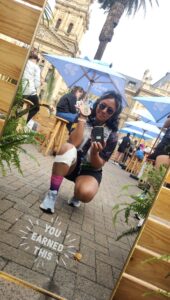
There are the runners who have trained for months, carefully building towards a distance that once seemed impossible. There are those who arrive with a personal goal, whether it is a new personal best or simply making it across the finish line. And then there are the runners who are still figuring it all out. Myself included, as I took on the infamous Koeksister Hill, known for its insane incline yet rewarding with a warm koeksister at the end. (I did not get my koeksister, I needed air and new legs).
As someone who took place, I know I had my own reasons for showing up.
That is what makes an event of this scale so special. Thousands of people can run the same roads and cover the same distance, yet each person carries a different story with them.
Some are chasing records. Others are raising awareness for causes close to their hearts. Some are running with friends and family, while others are quietly proving something to themselves.
And somewhere between the first kilometre and the finish line, all those individual stories become part of something bigger.
Running for a cause and celebrating every finish
The Nelson Mandela Marathon’s organisers have also encouraged runners to embrace the event’s ethos by running for a cause while remembering to enjoy the experience.
David Bellairs, chief operating officer of race organiser Galoza South Africa, highlighted the importance of seeing athletes of different abilities and finishing times taking part. For him, the atmosphere created by runners, supporters and the city itself is an essential part of what will make the event successful in the years ahead.
It is a sentiment worth holding onto. Sport is at its best when excellence and participation can exist alongside each other, when elite athletes inspire us without making the rest of us feel that our own efforts count for less.
Half-marathon runners deliver impressive performances
The day’s half-marathon competition also produced impressive performances.
Kenya’s Stephen Ngigi Kangethe won the men’s Slave Route Half Marathon in 1:03:58, finishing two minutes and eighteen seconds ahead of Yanga Malusi, who took second place in 1:06:16. Rowhaldo Ratz followed closely behind in 1:06:19 to complete the podium.
In the women’s category, Ethiopia’s Weynalem Haftu Gebre claimed victory in 1:13:41, finishing more than eight minutes ahead of Kirsti Bell, who placed second in 1:21:52. Trail runner Mila Geldenhuys completed the top three in 1:23:45.
These results added to a day of strong performances from African athletes on home soil, reinforcing the competitive promise of an event that organisers hope will attract leading runners from across the continent in future editions.
The real measure of success? Cape Town gees
So what does that mean for Cape Town? Well, for its inaugural event, I would guess it meant taking in all the information from this one as a benchmark and then bringing their game for next year.Because the lasting success of an event like this will depend on more than its podium finishes.
It will be found in the runners who return next year, the first-timers who discover a love for the sport, the communities that come out to support the field and the people who leave with the gees that, “yoh, that was nogal lekker”.

Leave a Reply